The
21-year old American B-17 pilot glanced outside his cockpit and froze. He
blinked hard and looked again, hoping it was just a mirage. But his co-pilot
stared at the same horrible vision. "My God, this is a nightmare," the co-pilot
said. "He's going to destroy us," the pilot agreed.
The men
were looking at a gray German Messerschmitt fighter hovering just three feet off
their wingtip. It was five days before Christmas 1943, and the fighter had
closed in on their crippled American B-17 bomber for the kill.
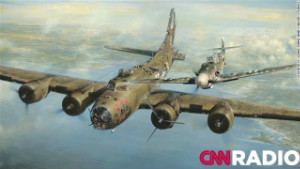 Brown's
Crippled B-17 Stalked by Stigler's ME-109 Brown's
Crippled B-17 Stalked by Stigler's ME-109
The B-17
pilot, Charles Brown, was a 21-year-old West Virginia farm boy on his first
combat mission. His bomber had been shot to pieces by swarming fighters, and his
plane was alone, struggling to stay in the skies above Germany . Half his crew
was wounded, and the tail gunner was dead, his blood frozen in icicles over the
machine guns.
But when
Brown and his co-pilot, Spencer "Pinky" Luke, looked at the fighter pilot again,
something odd happened. The German didn't pull the trigger. He stared back at
the bomber in amazement and respect. Instead of pressing the attack, he nodded
at Brown and saluted. What happened next was one of the most remarkable acts of
chivalry recorded during World War II.
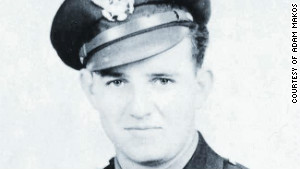 USAAF
Lt. Charles Brown USAAF
Lt. Charles Brown
Charles
Brown was on his first combat mission during World War II when he met an enemy
unlike any other.
Revenge,
not honor, is what drove 2nd Lt. Franz Stigler to jump into his fighter that
chilly December day in 1943. Stigler wasn't just any fighter pilot. He was an
ace. One more kill and he would win The Knight's Cross, German's highest award
for valor.
Yet
Stigler was driven by something deeper than glory. His older brother, August,
was a fellow Luftwaffe pilot who had been killed earlier in the war. American
pilots had killed Stigler's comrades and were bombing his country's
cities.Stigler was standing near his fighter on a German airbase when he heard a
bomber's engine. Looking up, he saw a B-17 flying so low it looked like it was
going to land. As the bomber disappeared behind some trees, Stigler tossed his
cigarette aside, saluted a ground crewman and took off in pursuit.
As
Stigler's fighter rose to meet the bomber, he decided to attack it from behind.
He climbed behind the sputtering bomber, squinted into his gun sight and placed
his hand on the trigger. He was about to fire when he hesitated. Stigler was
baffled. No one in the bomber fired at him.
He
looked closer at the tail gunner. He was still, his white fleece collar soaked
with blood. Stigler craned his neck to examine the rest of the bomber. Its skin
had been peeled away by shells, its guns knocked out. One propeller wasn'
turning. Smoke trailed from another engine. He could see men huddled inside the
shattered plane tending the wounds of other crewmen.
Then he
nudged his plane alongside the bomber's wings and locked eyes with the pilot
whose eyes were wide with shock and horror.
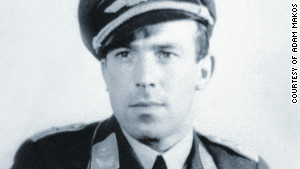 Luftwaffe
Major Franz Stigler Luftwaffe
Major Franz Stigler
Stigler
pressed his hand over the rosary he kept in his flight jacket. He eased his
index finger off the trigger. He couldn't shoot. It would be
murder.
Stigler
wasn't just motivated by vengeance that day. He also lived by a code. He could
trace his family's ancestry to knights in 16th century Europe . He had once
studied to be a priest. A German pilot who spared the enemy, though, risked
death in Nazi Germany. If someone reported him, he would be
executed.
Yet
Stigler could also hear the voice of his commanding officer, who once told him:
"You follow the rules of war for you -- not your enemy. You fight by rules to
keep your humanity."
Alone
with the crippled bomber, Stigler changed his mission. He nodded at the American
pilot and began flying in formation so German anti-aircraft gunners on the
ground wouldn't shoot down the slow-moving bomber. (The Luftwaffe had B-17s of
its own, shot down and rebuilt for secret missions and training.) Stigler
escorted the bomber over the North Sea and took one last look at the American
pilot. Then he saluted him, peeled his fighter away and returned to Germany
.
"Good
luck," Stigler said to himself. "You're in God's hands now..." Franz Stigler
didn't think the big B-17 could make it back to England and wondered for years
what happened to the American pilot and crew he encountered in
combat.
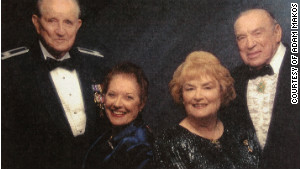 Charles
Brown, with his wife, Jackie (left), with Franz Stigler, with his wife,
Hiya. Charles
Brown, with his wife, Jackie (left), with Franz Stigler, with his wife,
Hiya.
As he
watched the German fighter peel away that December day, 2nd Lt. Charles Brown
wasn't thinking of the philosophical connection between enemies. He was thinking
of survival. He flew his crippled plane, filled with wounded, back to his base
in England and landed with one of four engines knocked out, one failing and
barely any fuel left. After his bomber came to a stop, he leaned back in his
chair and put a hand over a pocket Bible he kept in his flight jacket. Then he
sat in silence.
Brown
flew more missions before the war ended. Life moved on. He got married, had two
daughters, supervised foreign aid for the U.S. State Department during the
Vietnam War and eventually retired to Florida .
Late in
life, though, the encounter with the German pilot began to gnaw at him. He
started having nightmares, but in his dream there would be no act of mercy. He
would awaken just before his bomber crashed.
Brown
took on a new mission. He had to find that German pilot. Who was he? Why did he
save my life? He scoured military archives in the U.S. and England . He attended
a pilots' reunion and shared his story. He finally placed an ad in a German
newsletter for former Luftwaffe pilots, retelling the story and asking if anyone
knew the pilot.
On
January 18, 1990, Brown received a letter. He opened it and read: "Dear Charles,
All these years I wondered what happened to that B-17, did she make it home? Did
her crew survive their wounds? To hear of your survival has filled me with
indescribable joy..."
It was
Stigler.
He had
left Germany after the war and moved to Vancouver , British Columbia , in 1953.
He became a prosperous businessman. Now retired, Stigler told Brown that he
would be in Florida come summer and "it sure would be nice to talk about our
encounter." Brown was so excited, though, that he couldn't wait to see Stigler.
He called directory assistance for Vancouver and asked whether there was a
number for a Franz Stigler. He dialed the number, and Stigler picked
up.
"My God,
it's you!" Brown shouted as tears ran down his cheeks. Brown had to do more. He
wrote a letter to Stigler in which he said: "To say THANK YOU, THANK YOU, THANK
YOU on behalf of my surviving crew members and their families appears totally
inadequate."
One of
Brown's friends was there to record the summer reunion. Both men looked like
retired businessmen: they were plump, sporting neat ties and formal shirts. They
fell into each other' arms and wept and laughed. They talked about their
encounter in a light, jovial tone.
The mood
then changed. Someone asked Stigler what he thought about Brown. Stigler sighed
and his square jaw tightened. He began to fight back tears before he said in
heavily accented English: "I love you, Charlie."
Stigler
had lost his brother, his friends and his country. He was virtually exiled by
his countrymen after the war. There were 28,000 pilots who fought for the German
air force. Only 1,200 survived.
The war
cost him everything. Charlie Brown was the only good thing that came out of
World War II for Franz. It was the one thing he could be proud of. The meeting
helped Brown as well, says his oldest daughter, Dawn Warner.
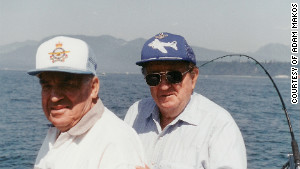 They met
as enemies but Franz Stigler, on left, and Charles Brown, ended up as fishing
buddies. They met
as enemies but Franz Stigler, on left, and Charles Brown, ended up as fishing
buddies.
Brown
and Stigler became pals. They would take fishing trips together. They would fly
cross-country to each other homes and take road trips together to share their
story at schools and veterans' reunions. Their wives, Jackie Brown and Hiya
Stigler, became friends.
Brown's
daughter says her father would worry about Stigler's health and constantly check
in on him.
"It
wasn't just for show," she says. "They really did feel for each other. They
talked about once a week." As his friendship with Stigler deepened, something
else happened to her father, Warner says "The nightmares went away."
Brown
had written a letter of thanks to Stigler, but one day, he showed the extent of
his gratitude. He organized a reunion of his surviving crew members, along with
their extended families. He invited Stigler as a guest of honor.
During
the reunion, a video was played showing all the faces of the people that now
lived -- children, grandchildren, relatives -- because of Stigler's act of
chivalry. Stigler watched the film from his seat of honor.
"Everybody
was crying, not just him," Warner says.
Stigler
and Brown died within months of each other in 2008. Stigler was 92, and Brown
was 87. They had started off as enemies, became friends, and then something
more.
After he
died, Warner was searching through Brown's library when she came across a book
on German fighter jets. Stigler had given the book to Brown. Both were country
boys who loved to read about planes.
Warner
opened the book and saw an inscription Stigler had written to Brown:
In 1940,
I lost my only brother as a night fighter. On the 20th of December, 4 days
before Christmas, I had the chance to save a B-17 from her
destruction,
a plane
so badly damaged it was a wonder that she was still flying.
The
pilot, Charlie Brown, is for me as precious as my brother
was.
|
|
| ----------------------------------------------------------------------------------------------------------- |
|
|
See You Again Next Sunday
|


No comments:
Post a Comment